
Ali Uchida

She has held exhibitions in Japan and abroad such as "On an Isolated Island" (2019 Musee F, Tokyo.) and "Mountain of the Dead and the Holy Island” (2020 Kamakura Drawing Gallery,Kanagawa.).
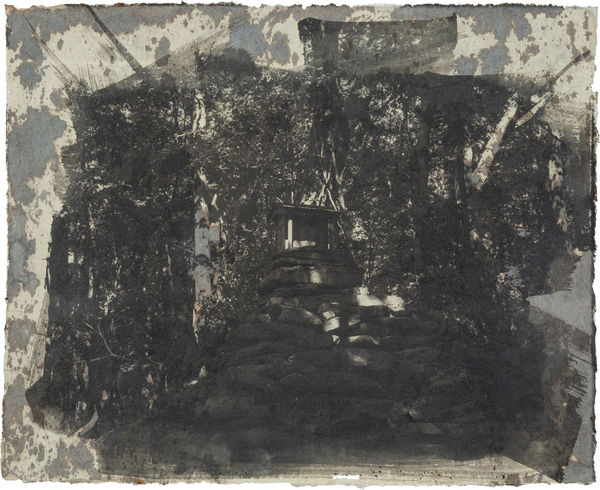
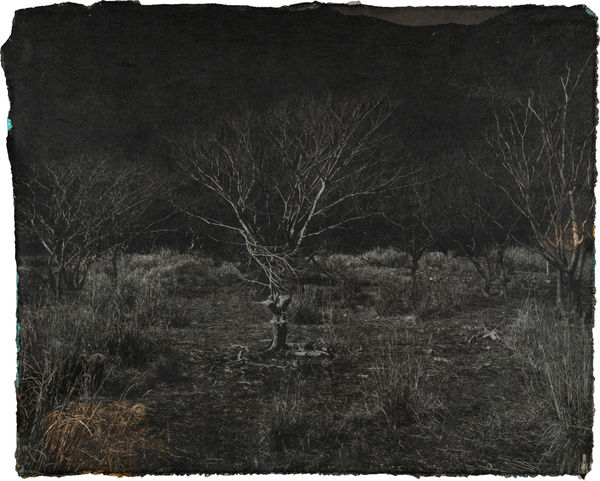
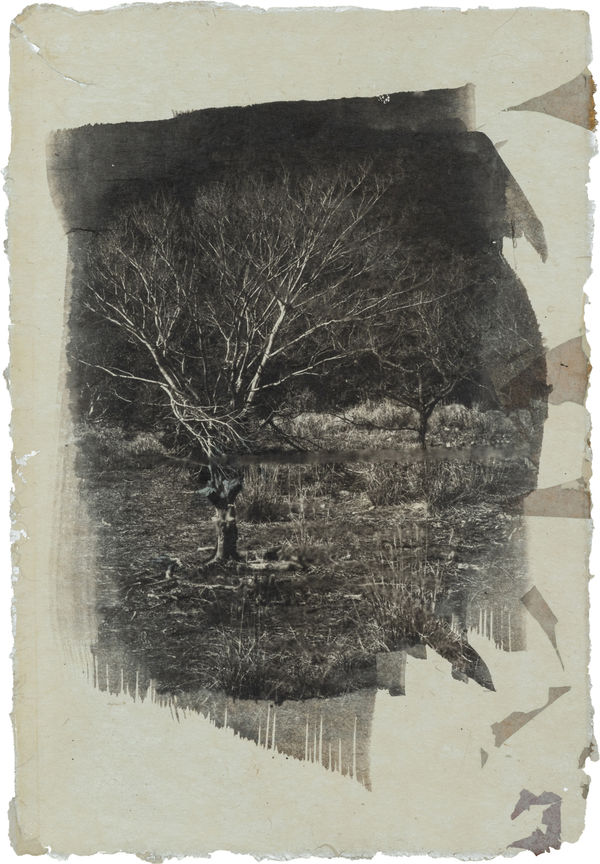
At the heart of Uchida’s practice is her series ‘HAFURI’. HAFURI is a long-term photographic project developed over an extended period of time on Tsushima Island, located between Japan and the Korean Peninsula.
Tsushima is often described as a border island or a geopolitical buffer zone. Yet such definitions fail to grasp the depth of time this land holds, or the accumulation of human activity that has settled here through repetition. Trade, movement, prayer, flight, suppression, and love—these were not events that merely passed through. They sank into the landscape, remaining as layered deposits within it. History here does not exist as a linear sequence of events, but as something embedded within terrain, atmosphere, and presence.
Mountains, coastlines, forests, abandoned roads, and ritual sites that remain without explanation do not appear as objects to be viewed. They emerge as presences that return our gaze. For me, the act of photographing is not a means of understanding or assigning meaning, but an attitude of remaining within the silence that the landscape itself emits.
The word hafuri is an ancient Japanese term that simultaneously means “to enshrine” and “to bury,” and once referred to mediators who stood between life and death, the sacred and the profane. These acts are not opposed. They are overlapping gestures through which time, loss, and continuity are negotiated. On Tsushima, this relationship feels spatially articulated. A mountain where gods are enshrined, a mountain where the dead are buried, and between them, a realm briefly opened for the living. This three-layered structure seems to quietly continue revealing how the land has long related to the world.
This project does not aim to explain such structures. It does not reconstruct rituals or rewrite history. Instead, it directs attention toward what continues to remain beyond language and record. Photography here is not an apparatus for revelation, but a sustained posture for remaining with the layers accumulated within the landscape. What is constantly questioned is not what is depicted, but how one is looking.
Human figures rarely appear in these works. This absence is not intended to exclude people. Tsushima holds many events that remain largely unrecorded within official histories: sea routes across borders, acts of rescue carried out in silence, grief that was never spoken. These persist not as narratives, but as tremors and presences within the land itself. Within this context, photography becomes a practice of listening rather than extraction. The camera is not used to seize decisive moments, but to remain with subtle shifts: light crossing a slope, coastlines enveloped in fog, waves resonating within unseen cavities. These elements do not assert themselves; they simply wait for attention.
The works are produced as platinum-palladium prints on ultra-thin, domestically produced gampi paper. The paper is left unsized, allowing the image to sink directly into the fibers. Metal leaf is applied to the reverse side, with animal glue used solely for its adhesion. Silver leaf, in particular, undergoes gradual chemical change over time, subtly altering the tonality of the image. Each work is constructed from five layers of paper. This layered structure reflects the conceptual framework of the project itself. The photograph is not a fixed statement, but a form of sedimentation—an entity that continues to change under the influence of light, humidity, and time. It is not a window, but a surface that contains duration.
The experience of being seen by the landscape does not bring reassurance or recognition. Rather, it exposes how provisional human existence is. The land does not fix meaning or guarantee identity. It simply places us in a position where we cannot remain unrelated. What HAFURI ultimately proposes is the landscape itself as a mediator—an entity that returns our gaze. It is a form of dialogue with the world that lies dormant where memory and prayer intersect. To continue standing before this question is, in itself, one response to the act of seeing.
-
 HAFURI No. 8, 2025
 -
HAFURI No. 6, 2025
-
HAFURI No. 5, 2025
-
HAFURI No. 2, 2025
-
HAFURI, 2025
-
HAFURI, 2025
-
HAFURI No.20, 2024
-
HAFURI No. 14, 2024
-
Hafuri, 2024
-
Untitled, 2023
-
Untitled, 2023
-
Untitled, 2023
-
HAFURI, 2023
-
Untitled, 2022
-
Untitled, 2021
-
Untitled, 2021
-
Untitled, 2021
-
Untitled, 2021
-
Untitled, 2021
-
HAFURI, 2021
-
HAFURI, 2021
-
Untitled, 2019
-
Untitled, 2017
-
Untitled, 2010




-
#75 10 Years IBASHO - Looking forward: New Talent Exhibition
24 Jan - 8 Mar 2026IBASHO concludes its 10th anniversary year. Where the celebrations began in March 2025 with 'Looking Back ' , the gallery now shines a spotlight on new and emerging talent in...Read more -
#70 Looking back: 10 Years of IBASHO
23 Mar - 18 May 2025We're excited to celebrate a big milestone at IBASHO: 10 years of sharing the beauty of Japanese photography. To mark this special moment, we're hosting a group exhibition “Looking Back:...Read more

